Where is the UCLA basketball program right now compared to where it has been the last ten years. In looking at what head coach Mick Cronin is achieving and where he has had to start from, we will look at the Kenpom ratings, a respected rating system that calculates a team's efficiency in many categories, though we will only focus on three of them for this piece.
The primary ratings are based on the Adjusted Efficiency Margin, which is basically the difference between the Adjusted Offensive Efficiency rating and the Adjusted Defensive Efficiency rating.
Per Kenpom.com, The Adjusted Offensive Efficiency is the "points scored per 100 possessions (adjusted for opponent)." The Adjusted Defensive Efficiency is "points allowed per 100 possessions (adjusted for opponent)." Simply put, these numbers represent what a team produces and allows, resulting in what a "team would be expected to outscore the average D-I team over 100 possessions."
Though I do not want to go deep into the mathematical process required to obtain these numbers (go HERE to get the specifics), a higher Adjusted Offensive Efficiency means a team scores more points and a lower Adjusted Defensive Efficiency means fewer points allowed to be scored. It is simply a measure of how good an offense is and how good a defense is and how the two compare to each other.
With that in mind, what has UCLA produced using the Kenpom numbers?
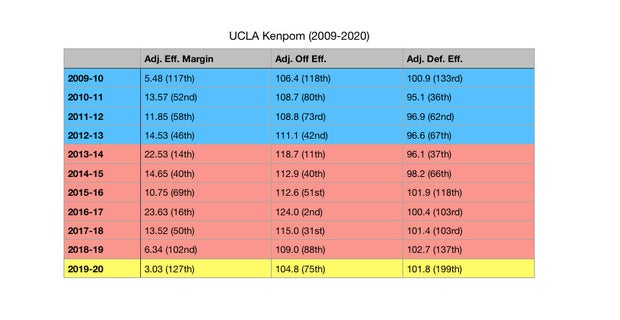
We can break this up into three parts based on the time the last three coaches have had control over the program. Ben Howland (blue) was in charge from 2009-13, Steve Alford (pink) was in charge from 2013-19 (Murray Bartow was the interim head coach during the conference part of the 2018-19 season) and Mick Cronin (yellow) has taken over the program starting this season (so the 2019-20 numbers are current and not final for the season).
There are two reasons for looking at these numbers. First, it will give an idea of how good or bad UCLA has done in the last ten years. Secondly, it will give us a look into where Cronin has to start in his tenure. According to the numbers, he has a long way to go.
Let us first start with a few reference points in regards to the teams in each of these seasons. To do this, we look at the players that were on the roster in some of the more significant seasons to give us a better understanding of why UCLA performed the way it did. The first year on the chart was Howland's seventh (two after the last Final Four run). Seniors included Nikola Dragovic, Michael Roll, and James Keefe. Freshmen included Brendan Lane, Mike Moser, Tyler Honeycutt, Reeves Nelson, and Anthony Stover.
The 2012-13 season (Howland's last) consisted of juniors David Wear and Travis Wear, sophomore Norman Powell and freshmen Jordan Adams, Kyle Anderson, Shabazz Muhammad, and Tony Parker. This team won the Pac-12 regular-season championship but was bounced in the first round of the NCAA Tournament.
The 2015-16 season was Alford's worst, according to the numbers. The team consisted of senior Tony Parker, juniors Isaac Hamilton and Bryce Alford, sophomores Thomas Welsh and Jonah Bolden and freshmen Aaron Holiday and Prince Ali. The next season was not only Alford's best squad but the best UCLA team in the last ten years as Lonzo Ball and TJ Leaf came in as freshmen to give the offense a boost. That was the last time Alford took the team to the Sweet Sixteen, the farthest he got in the NCAA Tournament.
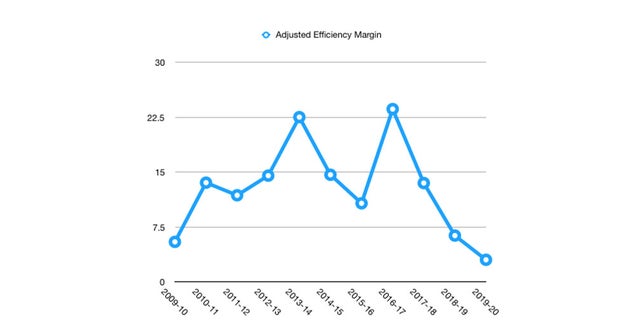
The state of the program was not good ten years ago. Howland was going through a tough stretch after those three Final Fours as his teams were not producing as it did early in his tenure. Though his defensive efficiency started to improve (lower adjusted defensive efficiency is better in these charts), it was not enough to save his job. Recruiting was not in good shape either, at least until 2012 when Howland claimed the no. 2 class in the nation. Unfortunately, Howland had high expectations placed on him in his final season, which he did not meet, leading to his removal and the hiring of Alford.
For a reference of how good UCLA's defense has been, here are the defensive efficiency ratings and rankings for Howland's teams during the Final Four years: 89.3 - 9th (2005-06), 88.3 - 2nd (2006-07), and 88.1 - 5th (2007-08). If those numbers were to be inserted in the chart below, all three would be plotted below the bottom line of the graph.
Alford implemented a looser, more uptempo style of basketball. That helped offensively, as five out of the six seasons he was in charge, his adjusted offensive efficiency rating was the highest it had been in the last ten years. Defensively, the team started to get worse under Alford. Though he had a good defensive efficiency in his first season (2013-14), it would increase and stay outside the Top 50 for the remainder of his tenure. In three of those years, it would not crack the Top 100. The worst it got was the 2015-16 season and that was when both offensive and defensive efficiency was bad under Alford, at least until the 2018-19 season when Alford was dismissed.
The one thing Alford could hang his hat on was the 2016-17 season with Ball and Leaf which produced the second-best offensive efficiency rating in the nation. Unfortunately, with both freshmen leaving, the offense was not as potent in the next few seasons.
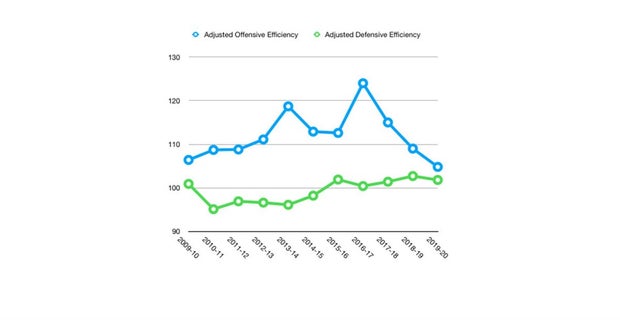
So where did that leave the program for Cronin? Though we are just over halfway through his first season, Cronin has the offensive efficiency continuing on a downward trend, though defensive efficiency has improved slightly. That is due to the change in philosophy the coach has brought to Westwood which is the opposite of what Alford did. UCLA's offensive efficiency rating has dropped this season, but that is because the team scores less often than last year's squad did (and because it is struggling to score overall).
Under Alford (and Bartow), UCLA scored 78.2 ppg while under Cronin, the team is scoring 72.0 ppg, which was expected, knowing Cronin's style of coaching. But on the other side of the court, the defensive numbers are improving. Not much, but it is improving as the Bruins' defensive efficiency is better than it was last season. We can also see that from the points allowed as Alford/Bartow gave up 77.8 ppg while Cronin is only giving up 68.3.
This is a time of transition for Cronin and he will definitely need that time to bring in his type of players and be able to fully implement his system. Right now he has a group of players that were brought in to execute an uptempo style basketball and not necessarily a defensive-oriented one. With that in mind, we are seeing individual improvements. Unfortunately, right now, it is not enough to have this team play at a competitive level, but once again, this is only Cronin's first season. His first half of a season.
"last" - Google News
January 12, 2020 at 02:03AM
https://ift.tt/2Nkx9pB
UCLA's Kenpom Ratings for the Last Ten Years - 247Sports
"last" - Google News
https://ift.tt/2rbmsh7
Shoes Man Tutorial
Pos News Update
Meme Update
Korean Entertainment News
Japan News Update

No comments:
Post a Comment